

 Posted by
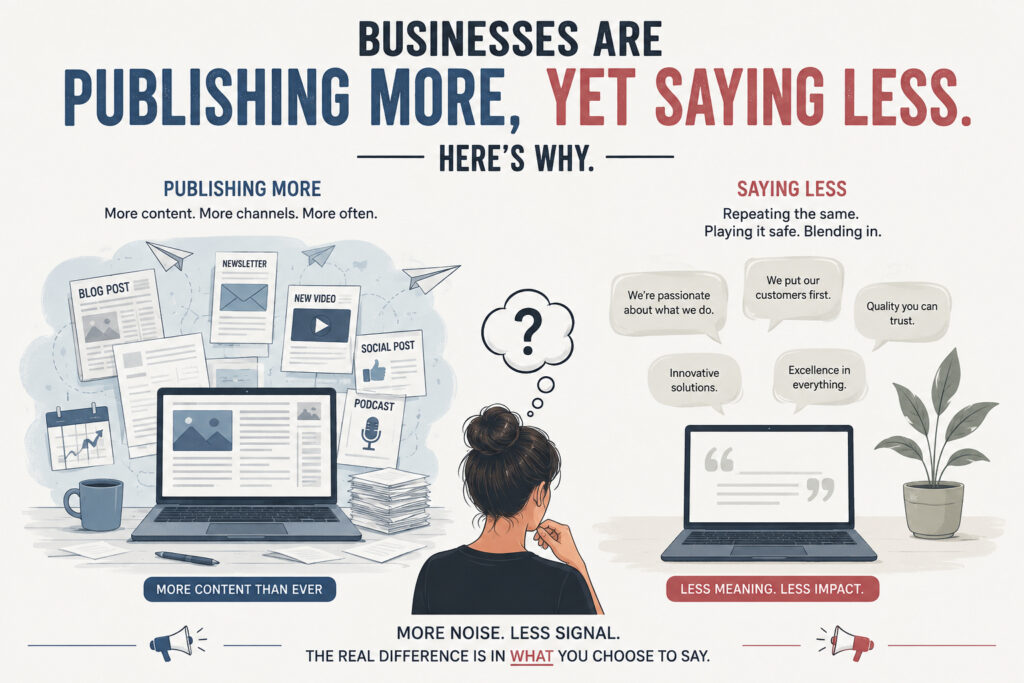
It’s a flood, an avalanche, a tidal wave of content we’re experiencing on a daily basis.
Digital copy has never been easier to produce. That’s why so many businesses have become a lot more prolific than they’ve ever been in the past.
Anywhere between 7.5 and 10 million new articles pop up in the digital space every single day, research suggests.That adds up to the incredible 2.7 billion pieces of new content generated on an annual basis.
Nearly 50 percent of these new articles rely heavily on AI for their creation. And while this isn’t necessarily a bad thing, it can lead to quality deterioration. AI in untrained hands has the capacity to produce some of the most mediocre texts you’ve ever come across.
The AI-isms that give away bad AI copy have become incredibly easy to identify. Seeing “in today’s world” in the intro immediately tells the reader what they’re in for. The same applies to “delve into,” “it’s crucial to note,” and let’s break it down.”
So what’s happening?
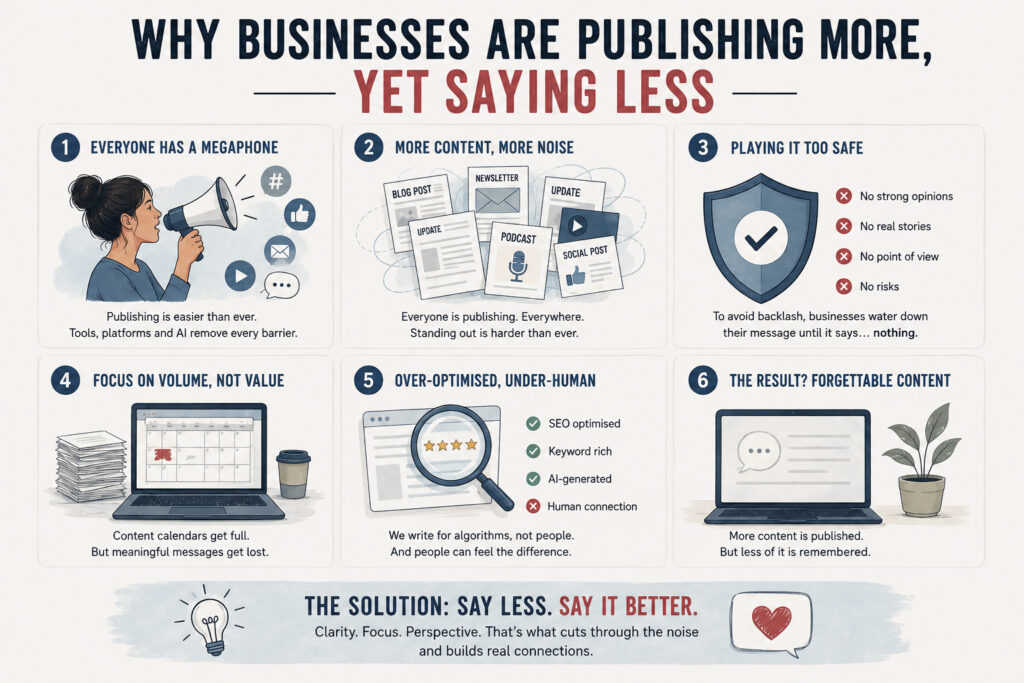
Businesses are publishing more than they’ve ever published in the past. At the same time, they’re not saying anything. Why is that, and what can be done about it? Here’s my non-AI-assisted take on the topic.
Cheaper & Faster: A World of Fast Manufactured Content
Digital content has very much become comparable to fast food: it costs almost nothing to create, it gets the job done somehow, and it’s the blandest version in existence.
The reason why so many businesses are publishing more than ever is easy to understand: copy has become incredibly cheap and incredibly fast to put together. This new reality doesn’t apply to written content alone. The same is true for infographics, visuals, even videos. With the right prompt, you can have any digital asset created for your brand in a manner of seconds.
In the past, there was some degree of exclusivity and gatekeeping.
Many smaller brands simply couldn’t afford to hire a copywriting or marketing agency to draft and execute a content marketing strategy. Their efforts remained somewhat amateurish, and the absence of quality was obvious.
AI has eliminated these obstacles. It can quickly produce decent-looking pieces. Many small business owners are drawn to the affordability and the pretense of quality. Digging a little deeper and looking beneath the surface, however, quickly reveals the lack of substance underneath the seeming polish.
How Does AI Write Content
To understand why AI content isn’t the Holy Grail of copywriting, we have to take a deeper look at what artificial intelligence does whenever a text generation prompt is input.
Models like ChatGPT have been “trained” through the provision of a large database of articles, books, web materials, and other texts. Whenever a prompt arrives, AI breaks it down into manageable “instructions” to understand the information requirements, tone, style, and voice preferences.
AI doesn’t think like a human. It also doesn’t employ creativity. Rather, the algorithm calculates mathematical probabilities to create the text output.
There isn’t an original thought or concept. ChatGPT regurgitates the information in its database and spits out an outcome that’s aligned with the specifics of the prompt.
Here’s a quick illustration of how that works. I asked ChatGPT to write a humorous, engaging introduction for this article. Here’s what it managed to produce:
Imagine walking into a networking event where everyone is talking at the same time. One person is enthusiastically explaining how they’re “passionate about innovation.” Another is “committed to excellence.” A third is proudly announcing they’re “redefining the future.” After ten minutes, you realise you haven’t learned a single thing about any of them.
Welcome to the internet in 2026.
As a copywriter who’s been writing for businesses for more than two decades, I’ve never seen companies publish so much content—or communicate so little. Every day, websites gain new blog posts, LinkedIn feeds overflow with AI-generated wisdom, newsletters land in inboxes with clockwork precision, and social media algorithms are fed their daily sacrifice.
Yet somehow, the more businesses say, the harder it becomes to remember what any of them actually stand for.
We’ve entered an era where content is abundant, but meaning is scarce. Quantity has become confused with authority, automation with expertise, and publishing with communication.
So, how did we get here? More importantly, how can businesses break free from the endless cycle of producing content that fills space but leaves no impression?
On the surface, it sounds just about right. Yet, it lacks personality and charm. The very same AI-isms we already talked abour are scattered throughout. There are tons of buzzwords (automation, expertise, clockwork precision). There are examples that are somewhat off. Lots of paragraphs, most of them repetitive. Can AI try to produce humor and engagement? Absolutely! Will it produce a result that most people find enjoyable? That’s questionable at best.
It’s Not About Quantity, It’s About Your Point of View
The content creation process has been cheapened. We’ve now entered the realm of mass manufacturing. This only means one thing for businesses.
Publishing more often doesn’t get the job done. In fact, poor quality can harm your reputation beyond repair.
Rather, having a unique point of view and sharing your expertise become vital. Today, building authority is the key to standing out. You have to establish yourself as the expert. You have to offer the reader something valuable and insightful, something that AI has no way of putting together.
“Boutique” content is the way to go. For you to impress, you have to offer a unique perspective, a deeper view, an original concept, even thought leadership that the audience wouldn’t be able to get elsewhere.
Your ideas matter more than the writing and the technical execution. Texts can be edited and polished. In the absence of a bright, standout concept, however, even the most flawless pieces will sound empty and superficial.
Types of Content to Prioritize if You Want to Make a Difference
So, you want your business and your content to be noticed for the right reasons. I recommend prioritizing the following:
- In-depth guides and articles
- Unique takes on professional topics
- Interviews with experts
- Thought leadership articles that focus on your experience and your ideas
- Personal stories, behind-the-scenes accounts
- Investigative pieces
- eBooks, whitepapers, and case studies
These types of content take longer to produce. They’re not the quick and easy articles ChatGPT can spit out on an ongoing basis. Often, you’ll need days and even weeks to make sure the outcome has enough substance before publishing.
That’s ok.
Sticking to a rigid editorial calendar is no longer that very important. Prioritizing quality rather than a schedule is the approach that builds a brand and sets you apart. Good ideas aren’t that easy to come by. Good execution also necessitates time. Once you make the switch from fast to boutique content, however, you’ll quickly notice the difference and the reputation establishment benefits.
The Starting Point: Know Who You Are
All of this sounds great, but you may be feeling somewhat confused. Where do you get started? How do you ensure consistency?
My main recommendation is to sit down and think about who you are and what you (or your business) stand for.
What’s the core message?
I’ll give you an example with my personal brand.
I am a copywriter who’s been in business almost 20 years now. I know how old-school content creation works, and I know what’s happening right now. My core message is that ideas matter. Creativity matters. AI tools can be amazing, but the human brain should power their work. I want to help businesses optimize content strategies and processes. I want to help them embrace new opportunities without eliminating the evergreen principles that ensure quality and sophistication.
I’m a wordsmith. I’m passionate about stories and storytelling. It’s not just copywriting, and it’s not just content creation. It’s a lot more comprehensive, artistic, and creativity-based.
While these are far from revolutionary concepts, they describe what I stand for. This foundation is employed each time I sit down to write a piece of content.
Forget about Formulas and Just Do You
If you go through a few online content creation guides, you’ll come across steps and principles like come up with an anchor asset, use it to turn that into additional content assets, continue producing content that enforces your message for a period of X days.
Blah, blah, blah.
These formulas don’t work.
Every business is unique. Its audience is unique. Being formulaic only kills authenticity.
I’d recommend just doing you. If you feel that a goofy tone is most representative of your brand, stick to that.
If you feel like your audience needs a detailed how-to ebook, take some time to put a quality piece together.
Don’t try to employ all the formulas, forget about a templated approach towards content creation.
Being authentic is vital. You can’t be authentic when you’re using shortcuts and formulas. Digital gurus promise solutions and roadmaps, as well as guarantees. All of that sounds lucrative until you buy the product. Most of them lack the deep understanding of your business to offer a tailored approach or to help you produce the strongest digital assets.
Get Some Assistance
Now that you have a strong concept, you can start looking for some assistance.
Using AI to brainstorm or come up with a tight structure makes sense. As a tool, it can save a lot of time and focus your efforts.
Deciding to partner with a professional is another rational approach that will elevate your strategy. Your ideas, paired with expertise and linguistic skill, will result in the wonderfully, deliciously different content that your audience will crave and engage with.
I can help you, guide you, write content for you. Would you like to chat? Contact me directly or drop a message on LinkedIn. I’d love to learn a bit more about you, about your business, and the wonderful content marketing opportunities we could explore together in the future.