

 Posted by
Who knows a company better than its founder or the people who have made the business the exceptional entity that it is today?
This knowledge definitely translates into copy that engages and converts in the blink of an eye, right?
If only it were that easy!
Intimate knowledge of a business or a product is only the first step.
Copywriting can’t be self-absorbed and complacent. It has to be purposeful and strategic. After all, a business is most often addressing people who are just getting acquainted with its philosophy, products, and accomplishments.
Some business owners make copywriting work because they have a good sense of what the audience wants and they create content with a purpose.
Most of the time, however, I’ve noticed copy that sounds good in theory but that fails impacting the audience in the desired way.
If your content isn’t delivering the anticipated conversions, you could be making one (or more) of the following mistakes.
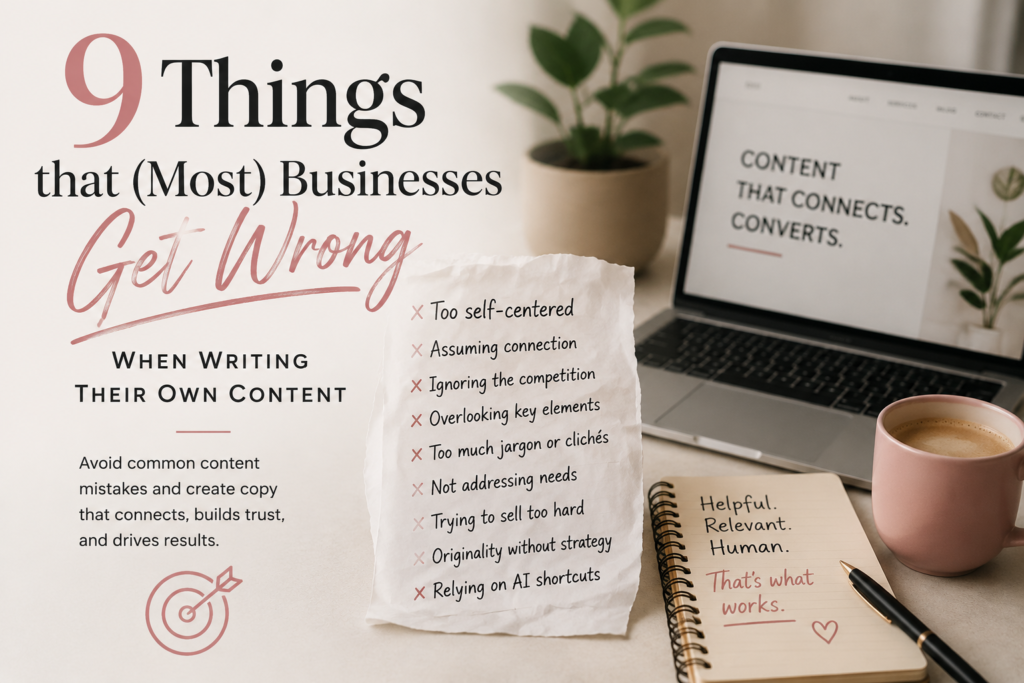
The Self-Centered Approach Doesn’t Work. Here’s Why
You care about your business, as you should. The problem is that you assume everyone else feels the same way.
Newsflash: they don’t.
Consumers today have choices. Tens (sometimes even hundreds) of them.
Why should they care about your brand? Why should they think what you have to offer is special and so much different from all the other options?
It is your responsibility to build that kind of understanding. By assuming that people already care and think your brand is great, you’re missing out on an opportunity to educate and establish an emotional connection.
Self-absorbed copy has the tendency to sound arrogant and pompous. Even if you’re just sharing your pride, there is still a risk of making the tone anything but the friendly and approachable one people will connect with.
Professional copywriters know that readers don’t really care about brands they’re just getting to know. Rather, they’re looking for useful information, entertainment, and emotional connection. Focusing on those free, rather than hyping up the brand, is the way to get a reader curious and eager to find out more.
Assuming the Audience Is as Emotionally Connected with the Brand as You Are
The very same rule applies to an established emotional connection.
Unless someone is a loyal buyer who spends 5,000 dollars per month on your products, consider them emotionally disengaged.
Ehrenberg-Bass Institute research suggests that as many as 82 percent of consumers don’t care about brand commitment. They will often purchase out of habit or convenience rather than emotion. Obviously, these figures vary from one sector to another, but you get the idea.
As many as 43 percent of consumers report they have no emotional connection to any brand whatsoever. Purchase decisions are typically driven by utility, familiarity, and a prior good experience. Half of all consumers have no favorite brand, and for 62 percent, brand connection means practical value in everyday life.
While an emotional component can be a powerful marketing tool, it will be challenging to instill. You’ll need time, consistent work, and an excessive focus on service and product quality.
When writing copy, don’t assume people feel something about your brand or products. Rather, inform, inspire, and entertain. Good content adds value to the reader’s experience. The emotional response emerges later on, and it’s not something you can take for granted.
Existing in a Vacuum (Having No Clue What the Competition Is Doing)
Good content takes into account the ecosystem that your business exists in.
You have competition. These competitors are working hard on their own marketing campaigns.
To be successful in terms of positioning, you have to know what they’re doing. You need a very precise idea of what makes you different and how you can establish your reputation within the industry.
If you’re doing competition research, on the other hand, you risk getting affected by the campaigns others are doing. We tend to emulate what we enjoy and consider valuable. Hence, your copy could start lacking originality. Having your campaigns resemble those of competitors too closely is in no way beneficial.
Neglecting the Importance of Key Elements Readers Notice
The way people read online is very specific. You need a good understanding of their habits and the hooks that trigger a response in order to optimize your marketing content.
Do you feel your headlines get people immediately curious? How about sub-headings, lists, pull quotes?
Even the way you format content can impact readers.
Bold text is something readers notice immediately. Everything else fades in the background. See what I did here?
People who specialize in marketing copy understand the importance of these elements. They have the experience and the background knowledge to optimize every aspect of content creation, tweaking words and phrases for maximum impact in ways that people who aren’t writers can’t fathom.
Too Much Jargon, Too Many Clichés
You live and breathe your business. The rest of the world doesn’t. It may seem that I’m making the point for the hundredth time, and I probably am. That’s because it’s an incredibly important point you need to understand really well.
Your knowledge of the field will often lead to the creation of specialized content filled with way too much jargon and technical specifics.
I’ve had to work with such texts. A client in the construction field wanted me to edit their articles and make them more approachable. While the texts contained a ton of useful information, they were so complex and specialized that most readers would have given up on the second paragraph.
Even if you’re operating in the B2B realm, you can’t assume your clients are as familiar with the specifics of your operations or products as you are. Good texts keep it simple. They explain complex ideas in a way that an 85-year-old granny can understand. This is where value comes from. The jargon may look professional and fancy to you, but it only serves as an annoyance.
An alternative approach may be to keep it too simple and adhere to easily-recognized clichés within your realm.
In that case, however, you aren’t sharing anything valuable or worthy of attention. The quality of information matters. The way you present this information is equally important. A winning strategy would be to turn a complex or very original idea into an approachable piece of content that will give the reader something beneficial and help you build your reputation as an authority in the niche.
A Failure to Address a Reader’s Problem or Need
Stating information for the sake of stating information isn’t enough.
Sure, useful and insightful content can build your authority. If you’re using it to generate leads and conversions, however, merely stating the facts or demonstrating your expertise isn’t going to be enough.
Good copy understands and validates pain points or frustrations that an audience is dealing with. Recognizing these and suggesting a viable solution (that your business is capable of providing) is the most meaningful way to establish a connection and ensure brand recognition in the long run.
Studies suggest that 62 percent of customers prioritize marketing content that specifically addresses their needs. Furthermore, content that recognizes and maps out the struggles and pain points of customers generates three times more leads at a reduced cost in comparison to traditional outbound marketing.
This means you have to turn the narrative around.
It isn’t about you. It’s about a prospective client. What do they want? What do they struggle with? Can you offer a solution that the potential consumer will find reliable every single time? If you can answer these questions before you get down to content creation, you’ll be on the path to marketing success.
Attempting to Directly Sell Through Copy
This point is somewhat related to the previous one, but it expands the concept even further.
Apart from recognizing audience struggles, you also have to understand what these people are looking for and what they consider valuable in terms of content.
One thing that nobody wants anymore is direct, heavy, and aggressive promotion.
Copy that oversells is never going to get the results you’re hoping for.
Rather, the goal of content marketing is a lot subtler.
It aims to build authority and recognition. It aims to establish a connection. That way, people will remember your brand or service whenever they start looking for a product or a particular solution.
“Buy now” calls to action don’t get the job done. Articles that scream “we are the best” will rather paint your business in a different light than the one you’re aiming for.
Use this opportunity to introduce yourself, what you do, what your business is all about. Share your expertise and your know-how. Add value through content creation, and these efforts will pay off in the long run.
Prioritizing Originality for the Sake of Originality
Cool, super original copy is awesome. I am impressed each time I see a well-executed content campaign that’s based on a distinctive angle, that has a point of view that only a few will ever consider.
Originality for the sake of originality, however, doesn’t get the job done.
You have to keep the goal of your campaign in mind first and foremost.
Are you trying to educate an audience about your niche and your products? Are you trying to establish yourself in a field of popular players? Are you currently in a campaign aimed at boosting sales?
Coming up with an original concept is great, but it’s not enough. Unless you’re strategic and you have a very specific reason to do what you want to do, chances are that your incredibly creative campaign will underperform.
The Elephant in the Room: The AI Shortcuts You’ll Be Shooting Yourself in the Foot With
Now that everyone has access to AI, everyone can label themselves a copywriter and call it a day.
After all, a brand new article for a website is one prompt away.
AI can be an incredibly powerful tool. At the same time, its misuse will make you lose your voice.
Excessive reliance on AI strips your content of substance and originality. Sure, you’ll have dozens of texts. Sure, you’ll feel good about it. How will an audience respond to AI slop, however? Will people engage, or will they go through the first few paragraphs and never look back?
Even if you use AI (I encourage you to, it’s a wonderful productivity tool), there still needs to be human creativity and input. AI copy lacks a distinctive point of view. It sounds generic. There is no depth and no valuable information. Your experience and knowledge are a lot more precious. Don’t sacrifice quality for the sake of quick turnaround time or reduced marketing expenses.
So, What’s the “Right” Approach?
There isn’t one.
Some business owners will become amazing copywriters who are their company’s strongest advocate.
Others will lack the time, knowledge, and experience to make a content marketing strategy deliver.
Outsourcing copywriting to a professional or hiring someone to handle content creation within your team tends to be the two approaches that deliver the best results.
An experienced freelance copywriter will quickly understand your needs, delivering the type of copy meant to optimize results. They’ll also be familiar with the latest marketing trends, helping you sharpen and update your approach.
In-house copywriting professionals will eventually gain deep knowledge of your brand. Such understanding is the key to producing impactful content your audience will want to engage with.
Sometimes, a hybrid approach will also make sense.
You could handle certain copywriting and marketing tasks on your own, while outsourcing bigger projects and campaigns. With so many professionals to choose from, you’ll easily discover the copywriter who “gets” your business and who delivers the best value.
Are you looking for ways to build your niche? Do you want to be noticed for all the right reasons? Let me help you! Copywriting is my passion, not just my career. As someone who’s been doing it close to 20 years, I know what businesses have to do in order to stand out. I also understand the evolving nature of content marketing and the ways to maintain appeal, regardless of new trends.
Let’s get in touch and discuss your marketing needs! Improved brand recognition doesn’t have to be challenging or costly if you have the right professional on your team.